
Beyond the Process: How a F.O.R.T. of Feedback, Opportunity, Recognition and Trust Strengthens Service Delivery
In this article:
Service Delivery Perspective
One of our supervisors still remembers a stretch of work that did not feel remarkable at the time. Steady, dependable, consistent. Nothing dramatic. Just showing up and doing the job properly across several client accounts that all needed attention at once. What changed things was not a single moment. It was noticing there was room to do more than the role technically required. Flagging a process that did not hold up under pressure. Picking up something nobody had assigned. A manager noticed. Not instantly, and not for any one reason, but enough to start handing over real responsibility: a client call, then training sessions for the wider team, then meetings run independently. None of it came with a guarantee it would go well.
Service Delivery gets measured in numbers: service levels, response times, resolution rates, client satisfaction. These numbers matter, and clients rely on them for visibility. But numbers only tell you what happened. They do not explain the moment a customer asks something that does not fit the usual pattern, or a client needs a judgment call instead of a standard answer. When you are holding that standard across several accounts at once, there is rarely a single script that covers all of them. In those moments, the outcome comes down to a person’s judgment. That is something people develop. It is not something a process document can hand them.
This is not only an internal observation. When Google studied what made its own teams effective, the strongest predictor was not who was on the team. It was how safe people felt to speak up, take a risk, or admit a mistake without it being held against them. Teams with that kind of safety consistently outperformed teams with more individual talent but less trust between them. Capability alone does not build a strong team. The environment around people does.
Building the F.O.R.T.
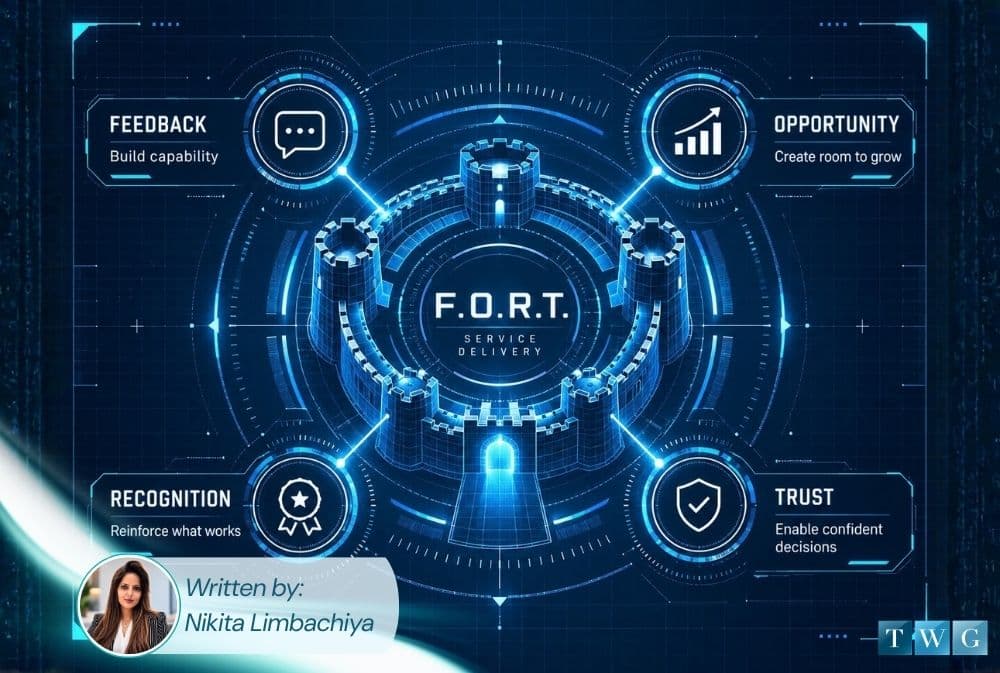
Creating that environment is not complicated, but it does not happen on its own. In our experience, it comes down to four elements working together: Feedback, Opportunity, Recognition, and Trust. We think of it as the F.O.R.T. that a strong Service Delivery team is built on. It is the structure that holds when a situation does not go according to plan.
Feedback
The manager who kept extending responsibility also gave direct, specific feedback along the way. One example: suggestions raised by the team in meetings were not always being acknowledged before moving to the next point, and silence in the room was being misread as disengagement rather than what it usually was: people thinking. Small observations like that rarely show up on a dashboard, but they change how a room experiences a conversation.
Alongside that came coaching on decision-making and running a team under pressure. Feedback like this only makes sense once someone actually holds the responsibility to apply it. Feedback is not commentary. It is a tool for capability development.
Opportunity
None of the responsibility showed up because someone was already fully ready for it. A client call, a training session in front of the wider team, a meeting run solo. These came before every part of the job was mastered, not after. People rarely arrive fully formed for the next level of responsibility. They grow into it once someone gives them room to try.
In an industry that runs on how well people handle the unexpected, waiting for certainty before extending opportunity usually means waiting too long. Opportunity is not a reward. It is a catalyst.
Recognition
The trust extended along the way came with recognition attached. Not vague praise, but a manager who consistently named, specifically, what was working. Being noticed for effort that most people would not have flagged is what turned steady work into motivation to keep improving.
That is the difference recognition makes when it is specific. It does not just make someone feel good. It tells them exactly which instinct to trust again. Recognition is not celebration. It is direction.
Trust
Handing someone a client call or asking them to train the rest of the team is not a low-risk decision. Not when there is a client on the other end of it. It is trust extended on the strength of everything that came before: the consistency, the questions asked, the initiative taken.
Trust does not mean removing oversight. It means someone has earned enough room to act, with enough support in place to keep learning while they do. Trust is not blind. It is informed confidence.
What This Looks Like in Practice
- None of this requires a large new programme. It shows up in everyday decisions:
- Give someone the opportunity to lead part of a discussion
- Ask for their view on a recurring problem and actually use it
- Be specific about why a contribution mattered
- Give feedback while the moment is still fresh
- Let people make decisions within clear boundaries and support them while they do
These are small actions, but they accumulate. They create an environment where people grow because someone trusted them before they felt fully ready.
The Part a Process Document Cannot Cover
That combination of being trusted with something before feeling fully ready, being recognized specifically enough to know what to keep doing, and getting honest feedback along the way is what turned one supervisor’s early growth into the next step in their career. It is a pattern that repeats across the people who grow here.
It is also why Service Delivery cannot be built through documentation and measurement alone. Strong process creates consistency. But when something unexpected happens, a person still has to interpret the situation, communicate with the client, and decide what happens next.
If you are evaluating a service delivery partner, this translates to fewer issues that need to reach you and a team that stays steady as the relationship grows. If you are deciding where to build a career, it is what growth actually looks like from the inside. Not a title change, but responsibility earned one moment at a time.
About the Author
Nikita is a Regional Project Manager at TalentWorldGroup. She joined TWG in 2019 as a Talent, bringing seven years of experience in customer support and service delivery, and has since grown into a Supervisor and then an RPM.
She is passionate about people development and creating opportunities for others to grow, especially because she has experienced that journey herself.
Originally from Surat, India, she enjoys working with people from around the world. Outside of work, she loves Bollywood music, shopping and simply taking time to enjoy the little things.
Share this article


Stay in the know
Discover more articles, explore emerging trends, and stay connected with the future of remote work, global recruitment, and business process outsourcing by staying informed with the latest industry news, expert perspectives, and insights from TalentWorldGroup.