
Artificial Intelligence Takes the Hardwood: What Robotic Concessions Teach Us About Human and Machine Collaboration
In this article:
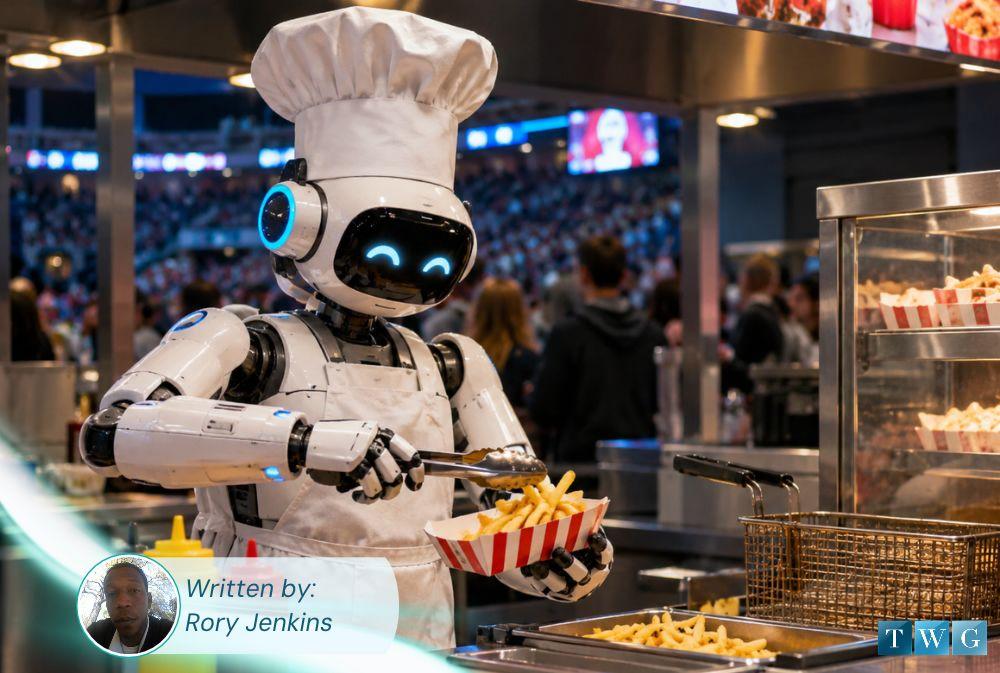
Artificial intelligence has moved from the analytics room into the concession stand. Miso Robotics recently announced that its AI-powered cooking assistant, the Flippy Fry Station, has shipped to its first National Basketball Association (NBA) arena. For venue operators who must serve thousands of fans within a few short breaks in play, the appeal is clear. The more interesting story, however, is not the robot itself. It is how the work around the robot changes.
What the Robot Does
According to Miso Robotics, the Flippy Fry Station uses computer vision and NVIDIA-powered AI to run the fry station, one of the hottest, most repetitive, and most volume-sensitive tasks in any kitchen. The company highlights four benefits:
- Throughput: Miso states that the system can process up to 100 baskets of food per hour, with cooking times controlled by software rather than by a busy cook watching a timer.
- Safety: Robotic arms handle the baskets, keeping staff away from hot oil. Miso reports no safety incidents in its live deployments.
- Consistency: The system identifies food items, monitors cooking in real time, and adjusts timing, reducing the variation that comes with manual frying during a rush.
- Redeployment of staff: With frying automated, venue staff can focus on taking orders and serving the fan in front of them, which is expected to help shorten queues at peak moments such as halftime.
The Real Lesson: Automation Moves People, It Does Not Replace Them
Set the novelty aside and the arena kitchen follows a pattern familiar to anyone who runs customer operations at scale. Demand arrives in surges. The repetitive part of the work is predictable and rule-based. The part that defines the customer experience, a friendly word, a corrected order, a problem solved before it becomes a complaint, remains human.
The value of the robot is not that it removes people from the operation. It is that it removes people from the part of the operation where they add the least value, and frees them for the part where they add the most. A fry station that runs itself is only worth the investment if the person who used to stand at it is now serving fans faster and better.
What This Means for Customer Experience Beyond the Arena
At TalentWorldGroup, we see the same principle every day in AI-augmented customer operations. Automation and AI handle the high-volume, repetitive steps: routing, data lookups, documentation, and first-line answers to simple questions. Our Talents, the trained professionals who serve our clients' customers, then focus where judgment and empathy matter most: complex inquiries, escalations, and the conversations that decide whether a customer stays.
Three lessons from the arena kitchen apply directly to any customer-facing operation:
- Plan for the surge, not the average. Arenas automate because demand concentrates into a few minutes. Contact centers face the same peaks after product launches, service outages, and billing cycles, and capacity should be designed around them.
- Automate the task, not the role. The most effective deployments target a specific, repetitive task and redesign the role around it, rather than attempting to automate an entire job.
- Measure the experience, not only the efficiency. Baskets per hour matter only if fans receive their food sooner and leave satisfied. In customer operations, handle time matters only alongside resolution and satisfaction.
Looking Ahead
Robotic kitchens are likely to spread across sports venues, airports, and other high-traffic hospitality settings as operators look for consistency during peak demand. The organizations that benefit most will be those that treat automation as a way to elevate their people rather than remove them.
So, would you order food prepared by a robot? Perhaps the better question is whether the person who handed it to you made your visit better. That is where the real competitive advantage lies.
About the Author
Rory was born in Newport News which is known as the tidewater area. Mostly known for the shipyard and being close to Virginia Beach. He holds a degree in IT, plus an AI engineering, and PC Pro certification. He also holds a CNA and Professional tax certificate.
In his spare time, you may catch him bowling or playing pool, traveling the US with ambitions to travel the world, or stuck at his computer debugging code.
Share this article


Stay in the know
Discover more articles, explore emerging trends, and stay connected with the future of remote work, global recruitment, and business process outsourcing by staying informed with the latest industry news, expert perspectives, and insights from TalentWorldGroup.